
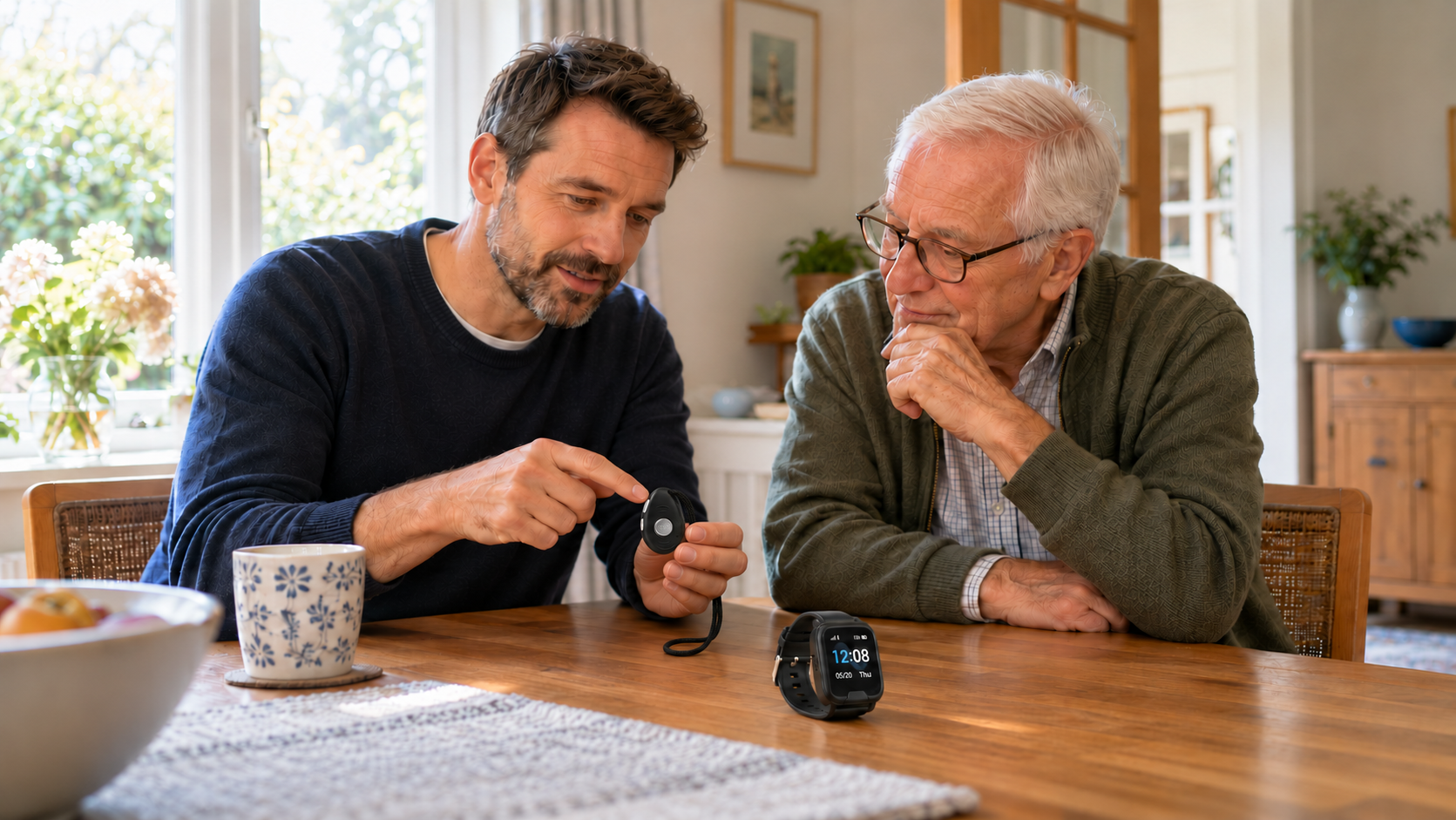
The best personal alarm for an elderly parent is usually the one they are comfortable wearing, understand how to use and can keep charged. Start with their routine and preferences, then compare features such as SOS, two-way voice, GPS, fall detection and monitoring. Buying the most feature-packed device is less useful than choosing one that becomes part of ordinary life.
This is often an emotional decision. You may have noticed Mum is less steady, Dad has had a worrying moment outside, or you are simply carrying more concern than you used to. A personal alarm can add a way to call for help; it cannot remove every risk or replace a conversation about wider support.
Begin with your parent, not the product page
It can be tempting to research quietly and present a solution afterwards. That approach sometimes makes a parent feel managed or judged. Begin by asking open questions instead:
- “Are there times when you would like it to be easier to get hold of someone?”
- “Would you feel more comfortable with a watch or something you can wear under a jumper?”
- “What would make it easier to keep doing the things you enjoy?”
Listen for practical details. Do they wear a watch? Are they happy charging a device? Do they have hearing or dexterity difficulties? Are they often in the garden, at a club or out shopping? These are more useful than a generic “Is it for falls?” question.
Step 1: decide where support is needed
The first fork in the road is simple: do they mainly need a way to ask for help at home, or would it be useful when out too?
For someone who still goes out independently, a mobile personal alarm can give a clear SOS option beyond the front door. The Anywhere Pendant and Anywhere Watch use their own mobile connection, so they do not need a landline or Wi-Fi. Location information can help the monitoring team during an alert, though signal and GPS availability vary.
If the concern is mainly indoors, compare this with a home lifeline service. Our guide to personal alarms versus home lifelines explains the differences without treating either as automatically better.
Step 2: choose a format they will wear
An alarm left in a drawer cannot help. The everyday fit matters.
A pendant may suit someone who wants a dedicated button
The Anywhere Pendant is lightweight and can be worn as a pendant or clipped to clothing. It can be a natural fit for somebody who wants a clear, purpose-built SOS control and does not mind wearing it around their neck or on clothing. It includes two-way voice, GPS and fall detection capability.
A watch may suit someone who already wears one
The Anywhere Watch can feel more familiar because it looks and functions as a digital watch. It has a dedicated SOS button, two-way voice, GPS and configurable fall detection. It also shows the time. For someone who gets dressed every morning and puts on a watch without thinking, that habit can be a real advantage.
Avoid deciding based on what you would choose. Ask your parent to hold or try the style where possible, and talk about when it would be worn: in the shower, while gardening, at night, or only outside.
Step 3: understand the features without overpromising
SOS button
This is the central feature. The wearer presses SOS when they feel unwell, unsafe, lost or need help. Encourage them to press it whenever they can rather than waiting for a problem to become dramatic.
Two-way voice and monitoring
Anywhere Care’s UK-based monitoring team can speak through the device after an alert and follow the details agreed for the person. That may include contacting nominated family, friends, carers or emergency services when appropriate. It is not a substitute for a carer, doctor or emergency service, but it can mean the person does not have to face the first step alone.
GPS
GPS gives location information, which is particularly useful away from home. It is not exact in every setting and can be less reliable indoors or in difficult signal conditions. The wearer should say where they are if they are able.
Fall detection
Fall detection may alert after some heavy falls, including when the person cannot press SOS. It can also miss some falls or create false alerts after ordinary movement. It is an additional layer, never a guarantee. Read how fall detection works before making it the deciding factor.
Step 4: make a response plan together
An alarm works with people and planning. During setup, decide:
- Who should be listed as contacts?
- Who lives nearby and is genuinely willing to be called?
- Is there a safe way for trusted responders to access the property?
- What information would help in an emergency, such as medication or mobility needs?
- When should your parent call 999 directly if they can?
Keep this realistic. A sibling who lives three hours away may be a useful contact, but not the only local response. If no suitable network is in place, or care needs are changing, ask the local authority, GP or relevant care professional for advice.
Step 5: check the everyday practicalities
Before you order, check the things that determine whether the device will be ready when needed:
- Charging: Both Anywhere Care devices need regular charging. Agree a visible, repeatable routine rather than assuming it will be remembered.
- Mobile coverage: The devices roam across UK mobile networks, but availability can vary. Ask about a location if it is a known poor-signal area.
- Water resistance: Both product pages state IP67 water resistance for showering and bathing. Follow the product guidance and keep ordinary bathroom safety measures in place.
- Cost and VAT: Current published pricing should be checked at checkout. VAT relief may apply only in specific circumstances; being older alone does not establish eligibility.
- Cancellation: Check the selected plan’s terms. Anywhere Care publishes a monthly option that can be cancelled at any time and an annual option; always confirm current terms before purchase.
Give it a proper first week
The first few days matter more than the unboxing moment. Help your parent charge the device, practise the button and remind them there is no shame in an accidental press. A quick check-in after a week can reveal whether a different charging spot, strap adjustment or format would work better.
Try to frame the alarm as a tool for their independence. It can make it easier to go to the shops or be in the garden with a straightforward route to support. If it becomes a symbol of losing control, pause and have the conversation again.
Frequently asked questions
What is the easiest personal alarm for an elderly parent?
“Easiest” depends on the person. A watch may feel natural for a regular watch wearer; a pendant may make the help button more obvious. The simplest device is the one they will wear and feel able to use.
Do personal alarms work outside the home?
Mobile personal alarms can work away from home using mobile coverage. The Anywhere Pendant and Watch are designed for at-home and out-and-about use, but connection and location can vary by signal and surroundings.
Does my parent need a smartphone?
No. Anywhere Care’s Watch and Pendant have their own SIM and do not need a smartphone, landline or Wi-Fi.
Should I choose fall detection?
It may be helpful as an additional layer for someone at risk of a heavy fall, but it cannot identify every fall. Consider it alongside, not instead of, the SOS button and wider falls advice.
Is a personal alarm enough if my parent is becoming confused?
An alarm can help someone ask for support, but it does not replace assessment or safeguarding arrangements. If confusion is new or increasing, seek advice from the appropriate health or care professional.
Related guides and useful links
- Compare the Anywhere Pendant
- Compare the Anywhere Watch
- See how an alert is handled
- Take the quick product quiz
A sensible next step
Choose a quiet moment to ask your parent what would make them feel more confident on an ordinary day. Then use that answer—not worry alone—to guide whether a pendant, a watch or a home-based service is the best place to start.