
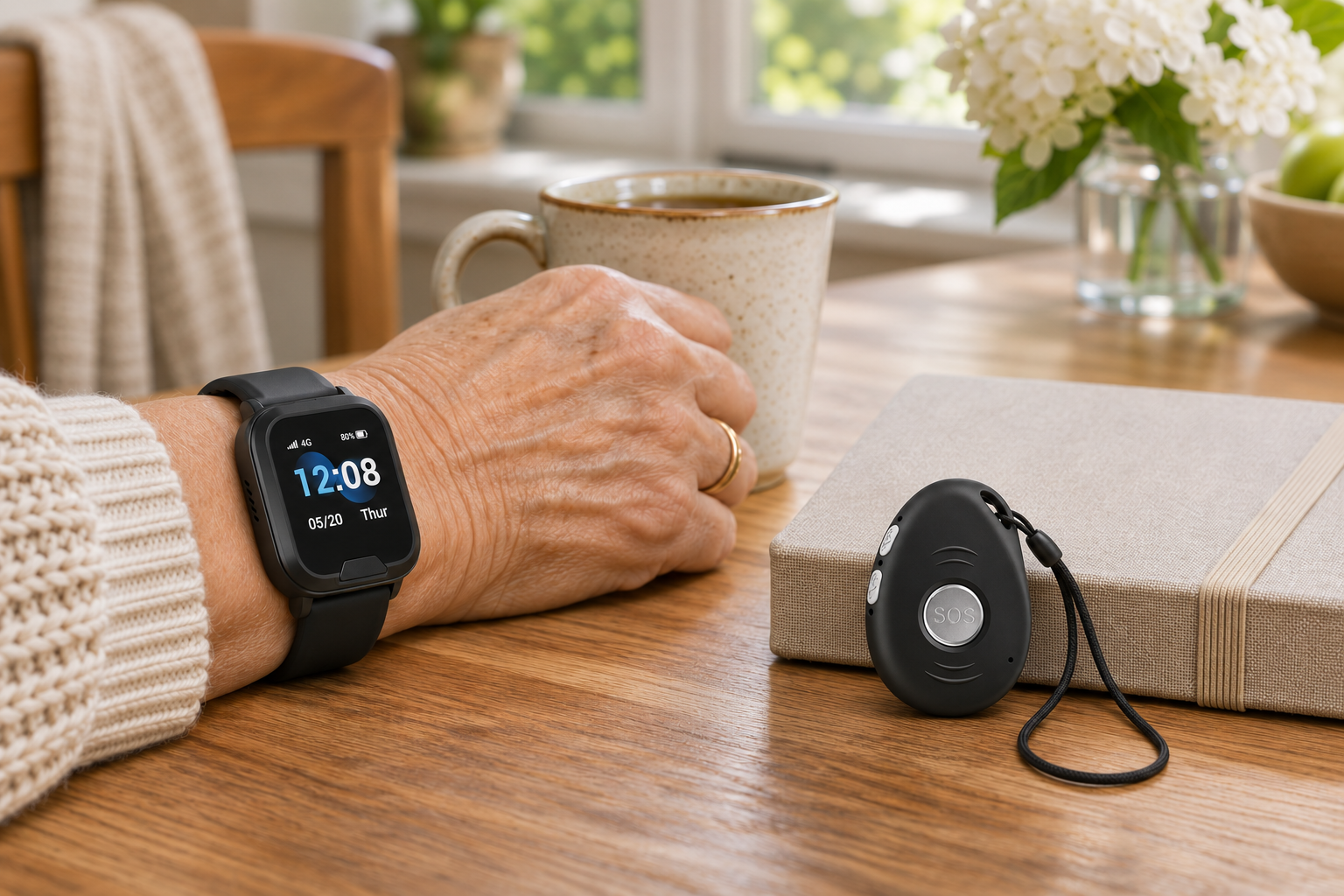
A personal alarm watch and a pendant can provide similar core support: an SOS button, mobile connection, two-way voice and GPS location capability. The best choice comes down to which form the person will wear, recognise and charge consistently. A familiar watch can blend into a daily routine; a pendant can make a dedicated help button easy to find.
There is no universally better option. Think about everyday habits, not just the emergency scenario.
What both Anywhere Care devices offer
The Anywhere Watch and Anywhere Pendant are wearable mobile personal alarms. Both have an SOS control, built-in mobile connectivity, GPS, two-way voice and fall-detection capability. They do not require a landline, Wi-Fi or smartphone. They are designed to connect to UK-based 24/7 monitoring when an alert is raised, subject to mobile coverage and battery.
Both are also described as IP67 water-resistant, so they can be worn for everyday washing, showering and bathing in line with the product guidance. Neither prevents an emergency, guarantees signal or replaces a carer, medical advice or emergency services.
The case for a personal alarm watch
A watch is often a good fit for someone who already wears one. It can become part of getting dressed, which reduces the chance of leaving it behind. The Anywhere Watch has a digital display, tells the time and weighs 40g including its strap according to the current product page. Its dedicated SOS button is on the side of the watch, and its fall-detection setting can be configured.
The watch can feel discreet because it resembles an ordinary digital watch. For some people, that makes a big difference: they may be more willing to wear it at a club, in the shop or when meeting friends. For others, a small side button may be harder to find if they have reduced dexterity or poor vision. The person should try the motion of pressing and holding it before deciding.
Charging uses a magnetic cable. That may be straightforward for one person and fiddly for another. The product page gives a typical 2–3 day battery life under standard use, but routines, signal and settings affect battery performance. A reliable charging habit matters more than the headline number.
The case for a personal alarm pendant
A pendant keeps the help button close to the chest, where it may be easier to locate deliberately. The Anywhere Pendant can be worn around the neck or clipped to clothing. It uses a charging dock and, like the Watch, has GPS, two-way voice and fall-detection capability.
For someone who does not wear a watch, a pendant can be the more natural choice. It may also suit people who want a device with one obvious purpose rather than a watch face. On the other hand, some people dislike necklaces, may take a pendant off at night, or do not want it visible over clothing. None of those preferences are trivial—wearing the device is what makes it available.
The Pendant’s published information says it gives an audible warning when a potential fall is detected, allowing the wearer to cancel a false alert if they are well. That is useful, but fall detection should still be treated as a back-up: it cannot detect every fall and a person should press SOS whenever possible.
Compare the formats by routine
| Everyday question | Watch may feel right if… | Pendant may feel right if… |
|---|---|---|
| Getting dressed | They already wear a watch every day | They are comfortable with a necklace or clip |
| Finding SOS | A side button feels easy to use | A dedicated front button feels more obvious |
| Appearance | They want something that looks like a normal watch | They prefer a simple purpose-built device |
| Charging | A magnetic cable is manageable | Placing it in a dock is easier |
| At night | They are happy to sleep in a watch | They would comfortably wear it or keep it close |
Ask these questions together
If you are choosing for a parent or someone you support, do not make the answer purely technical. Ask them:
- Which would you be more likely to put on every morning?
- Which feels easier to press with your usual hand movement?
- Where would you charge it?
- Would you want it while sleeping and showering?
- Do you ever take watches or jewellery off because of comfort?
A quick product comparison can highlight specifications, but this conversation identifies the device that has a chance of becoming habitual.
The SOS button matters more than fall detection
Both formats can include fall-detection capability, but the SOS button remains the most direct way to ask for help. The wearer should be encouraged to press it whenever they feel unwell, unsafe, lost or need assistance. They should not wait to see whether a fall alert activates.
After an alert, Anywhere Care says its monitoring team can speak through the device and follow the response details for that person. That plan should include current nominated contacts and a clear understanding of what to do if someone cannot answer. Read how an alert is handled with the person who will wear the device.
Avoid a false choice
The fact that one option is a watch and the other a pendant does not mean one is more “independent” than the other. Both can support a person to keep doing ordinary things with an easier route to help. The most respectful choice is the one the wearer genuinely prefers.
If neither feels right, do not force it. A home lifeline, a phone adjustment, care support or a different routine may suit better. A personal alarm is a tool, not a test of whether someone is coping.
It is also fine to change your mind after a short period of use. The right choice can become clearer once the wearer has tried charging, dressing with the device and using the SOS button in a calm setting. Revisit comfort and routine rather than assuming the first decision must be permanent.
Frequently asked questions
Is a personal alarm watch harder to use than a pendant?
Not necessarily. It depends on the wearer’s vision, dexterity and familiarity with watches. Practise pressing the SOS button before deciding.
Can a pendant or watch be worn in the shower?
Anywhere Care states that both are IP67 water-resistant and suitable for showering and bathing. Follow the product guidance and maintain ordinary bathroom safety.
Do both formats work outside?
Both use mobile connectivity and GPS, so they are designed for use at home and out and about where coverage is available. Mobile connection and GPS accuracy can vary.
Which one has better fall detection?
Both offer fall-detection capability, but it should not be treated as a guarantee. Choose primarily by the format the person will wear and use; press SOS whenever possible.
Can the device replace a mobile phone?
No. It provides a focused route to monitoring support but does not replace a phone for everyday calls, texts, apps or all emergency situations.
Related guides and useful links
- Explore the Anywhere Watch
- Explore the Anywhere Pendant
- Take the product quiz
- Learn about fall-detection limits
A sensible next step
Put the comparison table aside and think about tomorrow morning. Which device would the person most naturally put on before making a cup of tea or leaving the house? That is usually the format worth exploring first.